
Kintic: Two 19-Year-Olds Building the Data Layer for Humanoid Robots
Kavya Mohankumar and Pranavi Gogineni’s startup journey together started on an evening bus ride. Family friends since childhood, they reconnected as college students studying electrical engineering, math, and computer science.
As they sat next to each other, they chatted about topics that inspired them, such as how AI can shape the future of robotics. Drawn in by this connection, they started to share bigger questions: What do you see yourself doing in the future?
“Starting at a young age, I’ve always wanted to build a business,” said Gogineni, adding, “I realized that being in business is about resilience. If you’re willing to fail, you will learn from the challenges, and ultimately you will succeed.”
While Gogineni dreamed of starting a business, it was something Mohankumar, with a strong interest in the technical elements of robotics and computing, had never considered before.
And given their different interests and perspectives, this conversation changed the direction of both of their initial dreams.
“If I hadn’t met Pranavi, I wouldn’t have pursued entrepreneurship,” said Mohankumar. “When she said you just have to put your mind to it, I was surprised and impressed. I thought that it would be cool if we could build something together.”
Gogineni added, “Kavya was the exact co-founder I was looking for as I was planning to build tools and wanted to work with someone with strong technical skills.”
Mohankumar and Gogineni are now co-founders and CEOs of Kintic, which they are building as part of Georgia Tech’s CREATE-X Startup Launch Summer 2026 program at the Biltmore Innovation Center. Kintic is providing robotics companies with the real-world human activity data they need to train humanoid robots.
But Kintic wasn’t what Mohankumar and Gogineni set out to build when they were getting started.
Kintic’s Three Pivots: And What Was Learned Along the Way
Inspired by their bus ride conversation, Mohankumar and Gogineni dove right into building their first product, an AI DevOps engineer.
By pairing Mohankumar’s AWS certification and deep cloud expertise with Gogineni’s engineering expertise, they spent three months, including all-nighters coding, shipping 10 features. “We were proud of it. It felt like our baby,” said Mohankumar and Gogineni.
The problem was, they were so focused on building what they thought would be useful, they hit their first major challenge while marketing to companies. “Customer discovery hit us hard. Everyone thought it was cool. Nobody would buy it. Cloud access for a startup? Compliance nightmare. Too much trust to hand over to people they'd never heard of. We had no choice but to pivot,” said Mohankumar and Gogineni.
“We realized that we were too attached to the solution and that if we wanted to get to the next phase of building a startup, we would have to focus on customer discovery,” said Mohankumar and Gogineni.
“Each time we spun up a minimum viable product fast, got it in front of customers, made a little money, and realized the ceiling was too low, or they already had tools for the problem, such as when we built a tool to help with observability and spotting AI hallucinations,” said Mohankumar and Gogineni.
Each of these pivots gave Mohankumar and Gogineni a chance to refine their understanding of how to ask questions, listen to customers’ problems, and conduct initial marketing.
How Kintic Connects Robotics Companies to the Real-World Data They Need
It was during these customer discovery conversations, including with Georgia Tech robotics research labs, that they realized a true bottleneck: Companies and researchers training humanoid robots, which sense their environment and coordinate their physical movements using AI, don’t have nearly enough real-world data to work with.
“We kept hearing the same thing: the models exist, the hardware is getting there, but they’re starving for real-world data. One researcher told us that a robot can simulate a task thousands of times in a virtual environment and still fail completely the first time it tries the task in a real home. That stuck with us. We walked out of the conversation thinking, this is it. This is the missing piece. We didn’t sleep that night. We started building Kintic first thing the next morning,” said Mohankumar and Gogineni.
This was when Mohankumar and Gogineni’s interests in robotics and AI aligned with a real data pipeline problem that was holding back customers looking for both speed and security.
“We recruited almost 500 verified collectors in just four days, something that would take most data companies months,” said the Kintic Team, adding, “Every submission is tied to a verified identity and signed consent, and our entire pipeline runs on our own secure cloud infrastructure. The frontier labs need millions of hours of data, and we built Kintic to deliver it fast and securely.”
Kintic collects real-world human activity data and sells it to humanoid robotics companies and foundational model labs so they can train their robots to complete tasks in people’s homes, such as dishwashing, cleaning, and laundry.
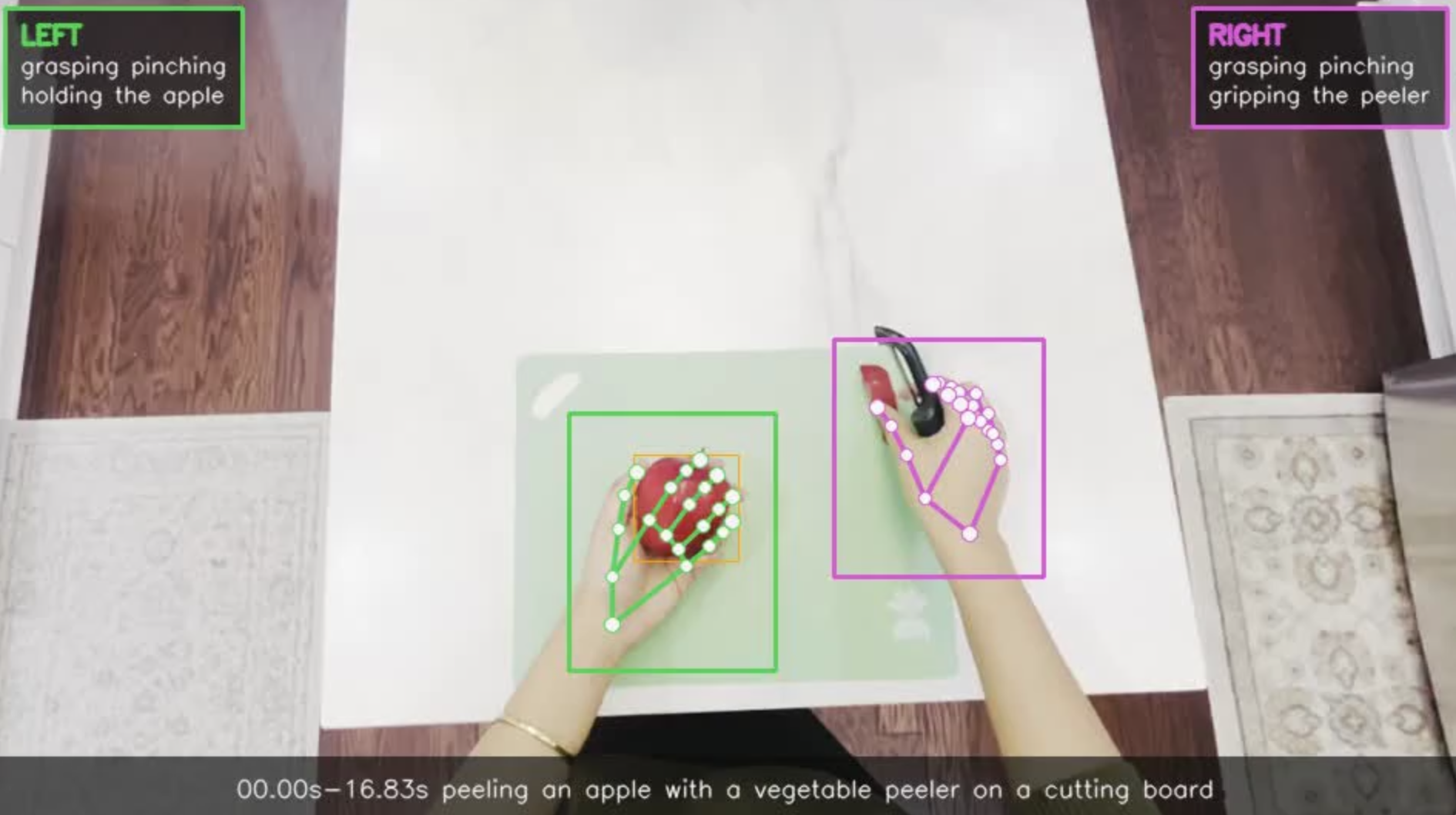
For humanoid robots to use AI and help with daily home tasks, they are trained with egocentric data, which is from a first-person point of view using a camera mounted on their head or chest, providing a video recording of hand and finger movements are made for tasks.
As people record residential tasks and chores at home, this provides data for the Kintic team to manually review and annotate for robotics companies. The data annotation includes conducting object detection and recording how the hands' joints move. Kintic is also developing simulation data from the recordings, which provides variations in shapes, colors, and environments.
While there may be similarities between how people complete these tasks at a high level, there are also differences, from hand movements to the physical surroundings in homes, which is why so much data is needed for training.

“Deal Before Demo Day”
Kintic’s goal when they started CREATE-X earlier this summer was to “close a deal before demo day.” And not only have they closed one deal, but they have closed several, including one that is up to seven figures.
“Getting our first deal felt unreal. We had been marketing so heavily that our first client actually found us. I just stared at the signed contract for a moment. That deal made everything feel possible,” said Gogineni, adding, “And then, when we closed the larger deal, Kintic started feeling like a real company. We immediately started thinking about how to best deliver this data securely and scale quickly.
Now that Kintic is gaining traction, backed by NVIDIA Inception’s program for startups in addition to Georgia Tech’s CREATE-X, Mohankumar and Gogineni are now in conversations with the robotics labs they are working with, navigating their newly booked calendars, and recruiting and training paid data collectors to collect egocentric data as they conduct their daily chores.
“Anyone could record this residential egocentric data; it’s a part-time job that you can do while you cook, clean, and do laundry at home and earn money,” said the Kintic Team, highlighting that no biometrics or facial data is collected as part of this work and that recordings undergo a QA process to ensure all sensitive information is masked.
“Earlier in the CREATE-X program, we saw peers closing deals, and we had no deals and no customers. And then, things progressed so rapidly,” said Mohankumar, adding, “To other founders who are building their startups, know that you’re not behind and you never know when something will happen.”
Expanding on the impact of the program, the Kintic Team said, “The CREATE-X program has given us so many resources to learn about entrepreneurship, mentorship, and connections for warm introductions, in addition to funding. This is one of the best things that Georgia Tech offers; the community is so nice and being part of a room full of founders who are working towards a goal, it’s an amazing experience.”
As co-founders, Mohankumar and Gogineni’s complementary interests and skills have provided a strong foundation for Kintic’s ongoing work and their future goals.
“Our long-term goal is building humanoid robots, with a focus on robotic prosthetics to help people with disabilities in their daily activities. There is so much to learn about robotics, and Kintic is giving us the opportunity to learn as much as possible about these different layers, from data collection to annotation and training of the AI datasets,” said Mohankumar.
While we didn't build the company we originally dreamed of, we built something better, because we refused to quit when it would have been so easy to,” said the Kintic Team.
On being friends, and now co-founders, Gogineni said, “It’s important for our vision to align. It’s difficult to be a solo founder; I’ve done it. Our visions align; we have the same goals. That’s what being a cofounder is about.”