
Now Out of Stealth, Askari Is Building Smarter, Decentralized Defense Systems
A new defense technology startup is emerging from stealth with a distinct perspective on a rapidly evolving problem. Askari Defense, founded by Robbie van Zyl,Benjamin Airdo, and Marc van Zyl, is developing systems designed to counter autonomous machines, beginning with drones but extending into a broader category of robotic threats.
The company recently relocated to Atlanta and operates out of the Biltmore Innovation Center, placing it within close proximity to Georgia Tech’s research ecosystem and a growing network of Department of Defense activity across the Southeast. For the founders, that geographic move was strategic.
“Georgia Tech is pumping out potential hires for Askari constantly,” they said, pointing to the Institute’s engineering talent pipeline and its connections to federal partners.
Askari also participated in Georgia Tech’s CREATE-X program, where the team built on an already established concept and refined its direction through mentorship. The founders noted that working with CREATE-X, particularly with mentor Rahul Saxena, helped them close key gaps in their early strategy.
Beyond Counter-Drone
While Askari is often described as a counter-drone company, the founders frame drones as only one part of a larger technological shift.
Their broader focus is on what they describe as counter robot detection and denial systems, technologies designed to identify, intercept, or disable autonomous machines across different environments.
That framing reflects how quickly unmanned systems have evolved in recent years. Conflicts such as the war in Ukraine and more recent conflicts in the Middle East have demonstrated how relatively low-cost drones can play an outsized role in modern warfare, often using techniques like frequency hopping to avoid traditional jamming systems.
Askari’s approach is to treat these developments not as isolated use cases but as signals of a broader trend toward autonomy.
“The threat is not just a drone,” the founders said, emphasizing that their long-term work extends beyond any single platform.
Designing for the Edge
A defining feature of Askari’s go-to-market wedge is its focus on the individual operator rather than centralized infrastructure. The company refers to this as “designing for the forward deployed individual,” meaning systems are tailored to be carried, operated, and trusted at the edge.
“The focus is on the human, the atoms of our force structure,” the founders said, describing how this principle shapes both the form factor and usability of their technology.
This approach stands in contrast to many existing defense systems, which are often large, centralized, and dependent on layered communication networks. Askari is instead prioritizing portability, autonomy, and direct usability in the field without setup or integration.
“If our systems effectively serve the atoms of warfare, then they can be easily scaled to serve the molecules,” they said, referring to individual operators in the field. Systems designed for frontline use, they added, can scale into broader applications such as base defense over time.
Autonomy and Onboard Intelligence
Askari’s systems use onboard computers to reduce reliance on external communications. In contested environments where signals can be jammed or degraded, this design choice becomes critical.
“The real-time processing and autonomy onboard the interceptor eliminate the need for two-way communications,” the founders explained.
Their systems integrate machine vision and artificial intelligence to operate with a high degree of independence. By building autonomy directly into the interceptors, Askari aims to reduce cognitive burden and increase reliability in real-world conditions.
The team frames this as a practical engineering constraint rather than a purely theoretical one.
“Physics cannot be patched,” they said, underscoring the limits of software-based solutions in physical environments.
This perspective informs how they approach countermeasures. Instead of relying solely on electronic warfare techniques like jamming, which can often be circumvented, Askari is exploring combinations of kinetic and autonomous responses that function against hardened threats, even when communications abilities are degraded.
Rethinking Cost and Deployment
In addition to technical design, Askari is also challenging prevailing economic assumptions in defense technology. “There’s a trend of companies going after expensive centralized systems,” the founders said. “We’re building something less expensive, easier to use, and decentralized.”
This strategy centers on logistical simplicity. By lowering both cost and operational complexity, Askari aims to make its systems more scalable and adaptable across different use cases.
The team frames this in terms of cost asymmetry, pushing back on a common benchmark in defense discussions: cost-per-kill.
“There are always cheaper ways to engage a target,” the founders said. “But cost-per-kill doesn’t always account for what it takes to actually deploy those systems.”
While often used to compare technologies, cost-per-kill typically focuses on the price of a single engagement and overlooks the broader system requirements. Platforms that advertise low cost-per-kill, such as lasers, vehicle-mounted turrets, or high-power microwave systems, often depend on significant infrastructure, power, logistics, and personnel to operate effectively.
Askari instead focuses on how capability and deployment scale together. Their systems are designed to be effective while remaining portable and easy to deploy, reducing the logistical burden required to operate them.
This model could allow for broader use without the same level of infrastructure investment, aligning with how modern conflicts are increasingly shaped by distributed systems and smaller units operating at the edge.
Navigating the Defense Ecosystem
Askari’s primary customers are expected to be U.S. and allied government entities. While defense procurement involves complex requirements and long adoption cycles, the company is deliberately structuring its approach to move faster than traditional pathways allow.
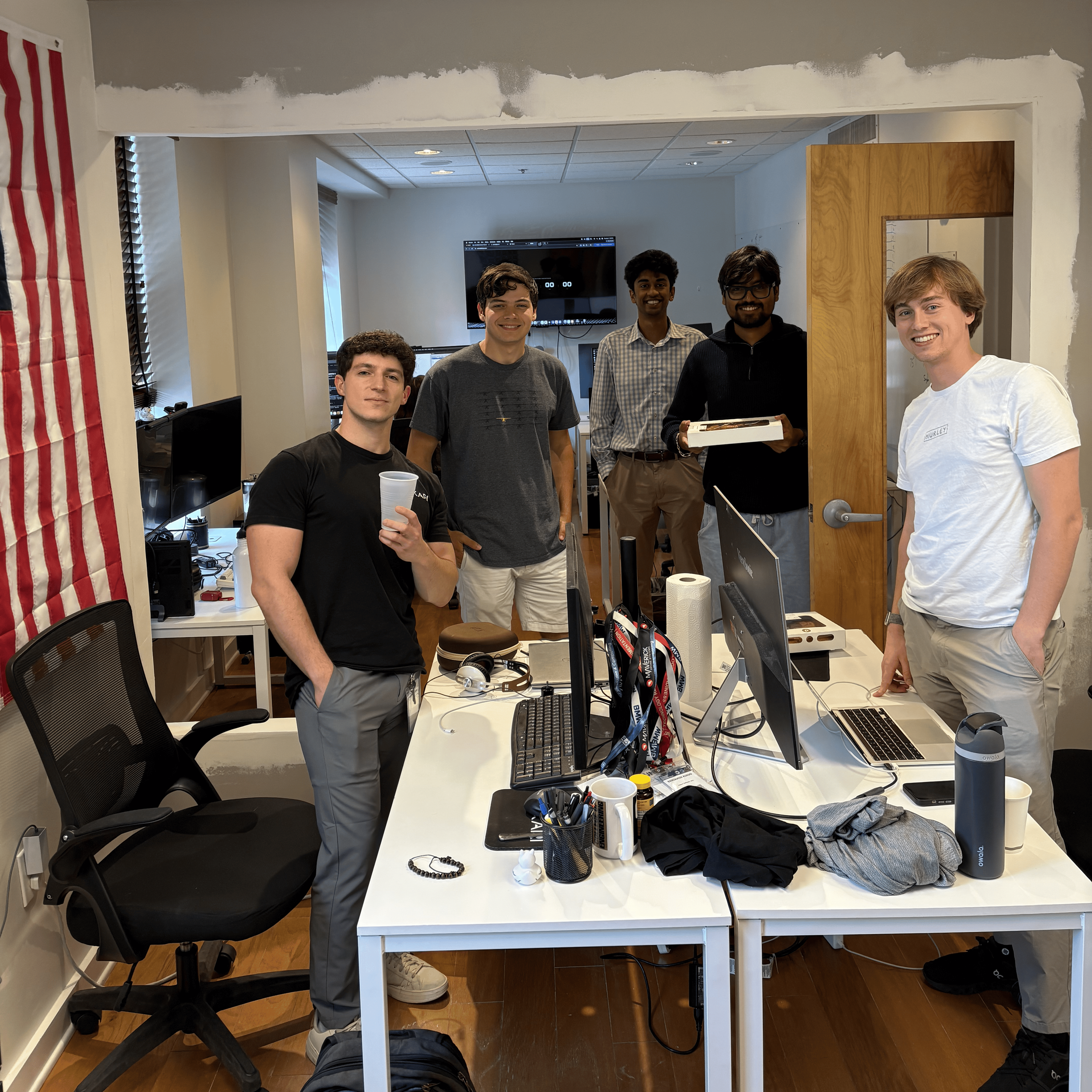
Askari team out of stealth celebration (Image: Askari)
“We understand that adoption within government systems takes time,” the founders said, “which is why we’re focused on building pull from the ground up.”
Rather than relying solely on top-down acquisition, Askari is engaging directly with end users operating in the field, including soldiers. By prioritizing operator needs, the company is developing systems that deliver immediate, tangible value, enabling rapid iteration and strong user advocacy early in the lifecycle.
This bottom-up strategy is designed to complement formal procurement channels by creating internal demand, accelerating trust, and increasing the likelihood of broader institutional adoption over time.
The founders are positioning themselves within a focused segment of the defense market where speed, usability, and operator alignment are critical differentiators.
Their relocation to Atlanta reflects that strategy. The Southeast provides proximity to key defense hubs across neighboring states, along with access to research institutions and a growing base of engineering talent.
“We’re fast, loud, and fiery,” Ben said, describing the team’s operating style as they prepare for their next phase.